
At some point, most people dealing with chronic knee pain hear a version of the same story. The cartilage is worn. The joint is degenerating. Injections might help for a while. Eventually, surgery may be the only option.
For some people, that conversation is accurate. But for a significant number of people with painful or unstable knees, it is not the full picture. And acting on it too early, or without understanding what is actually driving the symptoms, leads to interventions that address the joint without addressing the underlying mechanics that put the joint under stress in the first place.
Painful knees are rarely just a knee problem. They are almost always a movement problem. And understanding that distinction changes what recovery looks like entirely.
Why the Knee Is Usually Not the Root Cause
The knee sits between two major load-sharing joints: the hip above and the foot and ankle below. It does not operate in isolation. Every step you take passes force from the ground up through your foot, ankle, knee, hip, and into your spine. When the joints above and below the knee are functioning well and absorbing their share of that load, the knee handles its portion without problem.
When they are not, the knee absorbs more than it should. Over time, that excess load produces the symptoms most people associate with knee pain:
- Pain on the inside or outside of the knee that gets worse with stairs or prolonged walking
- Stiffness after sitting that takes several steps to ease
- A grinding or clicking sensation with movement
- Swelling that seems to come and go without a clear cause
- Pain that is worse first thing in the morning or at the end of an active day
- A feeling of instability or like the knee might give way
These symptoms can appear in many different knee conditions, including patellofemoral pain, early osteoarthritis, and irritation around the meniscus. The condition name matters less than the question underneath it: why is this knee absorbing more load than it should, and where is that extra load coming from?
The answer is almost always found in a combination of hip weakness, altered foot mechanics, and movement patterns that have compensated around those deficits for long enough to become automatic.
What Happens When Hip Strength Is the Missing Piece
The hip controls how the knee tracks during movement. When the muscles of the hip, particularly the stabilizers of the pelvis and the external rotators, are not doing their job, the femur drops and rotates inward with each step. This causes the knee to cave toward the midline, a pattern sometimes called a valgus collapse, which concentrates stress on the inner structures of the knee and alters how the kneecap tracks in its groove.
Most people with chronic knee pain have never been told this. They have been given quad stretches, foam rolling protocols, and exercises focused on the knee itself. The knee may feel temporarily better, but without addressing the hip, the mechanics that created the problem remain intact.
Targeted hip strengthening, especially work that builds capacity in the hip stabilizers, the external rotators, and the glutes, changes the way force moves through the knee during every step, squat, and stair. It is one of the most reliable and underused interventions for knee pain.
How Foot Mechanics Feed Into Knee Pain
The foot is where force absorption begins. When the foot is weak or collapses into excessive pronation, that inward roll does not stay at the ankle. It drives internal rotation of the tibia, which in turn affects how the knee tracks and where load accumulates within the joint.
This is why people with flat feet or significant pronation are disproportionately represented among knee pain patients. The foot mechanics are not just a foot problem. They are altering the stress environment at the knee with every single step.
Addressing foot strength and mechanics alongside knee rehabilitation is not supplementary. For many people, it is essential. Without it, the load that keeps wearing on the knee is never actually redirected.
The Four Pillars of Rebuilding Knee Stability
When knee pain is approached as a movement problem rather than a joint problem, the treatment strategy changes. Instead of managing symptoms in the knee, the goal becomes restoring the mechanics that allow the knee to share load properly. That requires work across four interconnected areas.
1. Targeted Strengthening
Strengthening for knee pain is not about doing leg extensions or squats for the sake of building muscle around the joint. It is about rebuilding the specific capacity that has been lost in the muscles responsible for load distribution.
For most people, this means progressive work targeting the hip stabilizers and external rotators, the posterior chain including the glutes and hamstrings, the calf complex for its role in absorbing ground forces, and the quadriceps in controlled eccentric loading patterns that train the muscle to decelerate force rather than just produce it.
The progression matters. Starting with movements that the nervous system can execute with correct mechanics, then progressively increasing load and complexity, builds capacity without reinforcing the compensation patterns that are already present.
2. Mobility Work That Actually Addresses the Right Restrictions
Tightness around the knee is often a symptom of restriction elsewhere. Limited hip extension causes the knee to work harder during walking and running. Restricted ankle dorsiflexion forces compensation at the knee during squatting and stair climbing. Thoracic stiffness affects how load is distributed through the entire lower extremity.
Effective mobility work for knee pain is not about stretching the knee itself. It is about restoring range of motion in the hip and ankle so that the knee is no longer being asked to compensate for what those joints cannot do. When hip and ankle mobility are addressed alongside knee strengthening, the improvements in knee symptoms tend to be faster and more durable.
3. Gait Training
How you walk is one of the most significant determinants of how much stress accumulates in your knee over time. Most people with chronic knee pain have unconsciously modified their gait to protect the joint, which often means shorter stride length, reduced hip extension, altered arm swing, and a subtly different foot contact pattern. These modifications reduce pain in the short term but change how load moves through the knee in ways that create new problems over time.
Gait training looks at the full mechanics of walking, including cadence, stride length, foot contact, hip extension, and how the pelvis moves through each step. Small corrections in gait mechanics can meaningfully reduce the load the knee is absorbing with every stride, which adds up significantly over the course of a day.
4. Movement Retraining
Gait is one movement pattern. But the knee is stressed by many others: how you rise from a chair, descend stairs, land from a step, or rotate under load. Movement retraining addresses the full range of daily and functional movements that load the knee, correcting the mechanics that have become habitual and replacing them with patterns that share load more effectively across the hip, knee, and ankle.
This is where lasting change tends to happen. An exercise done in a clinic strengthens a muscle. Movement retraining changes how that muscle is recruited during every movement you perform throughout the day. The difference in outcome is significant.
When Regenerative Therapies Play a Supporting Role
For some people, particularly those dealing with significant tendon irritation, early degenerative changes in the joint, or tissue that has not responded well to loading alone, regenerative therapies can help create the conditions for movement retraining to work more effectively.
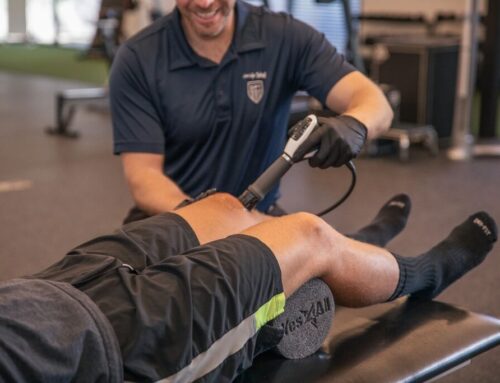
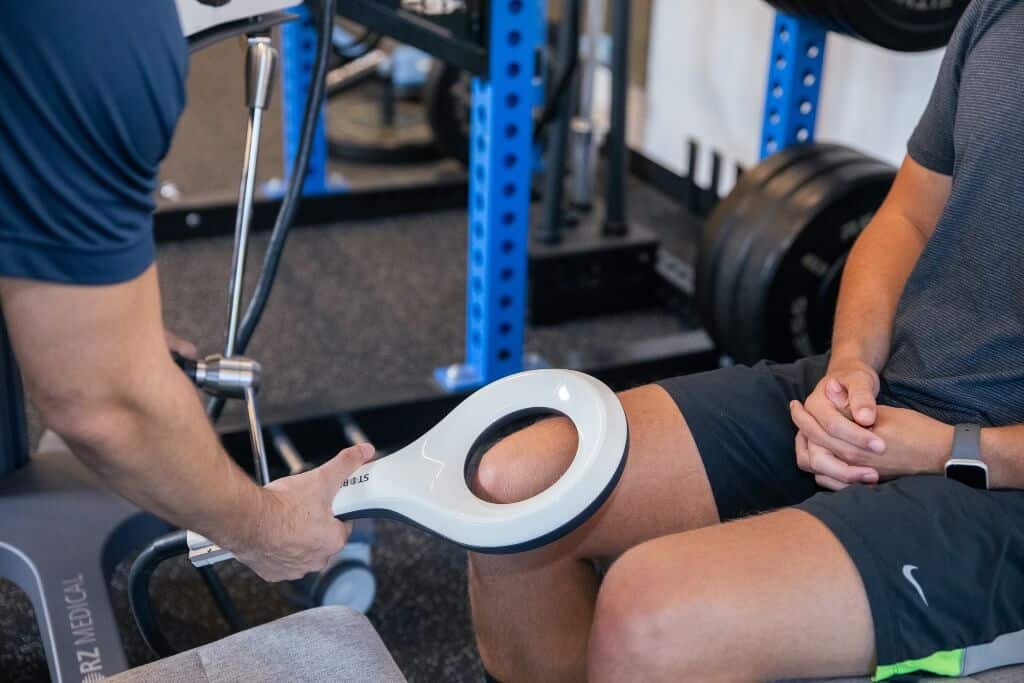
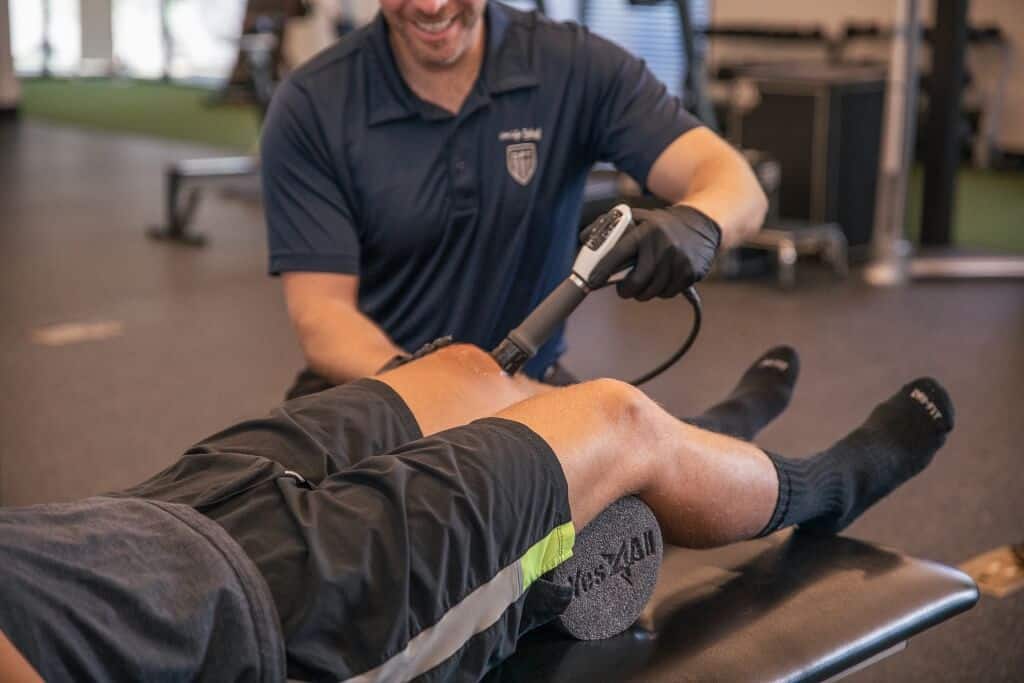
DPT offers two options in this category. Extracorporeal Pulse Activation Technology (EPAT), a form of shockwave therapy, uses acoustic pressure waves to stimulate circulation and trigger the body’s natural tissue repair process. It is especially useful for chronic tendon conditions around the knee, where the tissue has become stuck in a cycle of incomplete healing. Extracorporeal Magnetotransduction Therapy (EMTT) uses high-energy electromagnetic fields to reduce inflammation and accelerate healing in deeper musculoskeletal structures. The two therapies are often used together when indicated.
The key distinction is that these therapies work alongside movement retraining, not instead of it. Reducing pain and inflammation can make it easier to load the knee progressively and retrain movement patterns. But the mechanics that were overloading the knee in the first place still need to be addressed. Without that, the relief these therapies provide tends to be temporary.
A Simple Way to Start Paying Attention
Before your next walk, take a moment to notice a few things about how your knee behaves during normal movement.
As you walk, does your knee track forward over your second toe, or does it drift inward? Is there a difference between how your right and left knee feel when you go up or down stairs? When you sit down and stand up from a chair, does one knee feel weaker or less stable than the other?
You are not trying to correct anything yet. You are simply gathering information. If you notice that your knee consistently drifts inward during loading, that your pain is always worse after long periods of sitting, or that one side feels significantly different from the other, that is worth bringing to a clinical assessment. These patterns point toward the specific mechanics that need to change, and they are exactly the kind of detail that shapes an effective treatment plan.
What Most People Have Not Been Told
The conversation around knee pain tends to jump quickly to structure. What does the imaging show? How worn is the cartilage? Is the meniscus involved? These are relevant questions, but they are often treated as the whole story when they are actually part of a larger picture.
Structural findings on imaging do not always correlate with pain or function. Many people have significant degenerative changes on an MRI and no meaningful pain. Many others have knee pain that does not match what the imaging shows at all. What tends to predict outcomes more reliably is whether the mechanics driving the knee have been identified and addressed.
Surgery and injections can be the right answer in the right situation. But for many people dealing with chronic knee pain, the missing piece is not a procedure. It is a movement assessment that identifies where load is accumulating, which muscles are underperforming, and how the body is compensating around those deficits.
If you have been managing knee pain without that picture, a movement assessment at DPT is a logical place to start. A discovery visit gives you the opportunity to talk through what you are experiencing and determine whether a more thorough evaluation makes sense for where you are right now.