

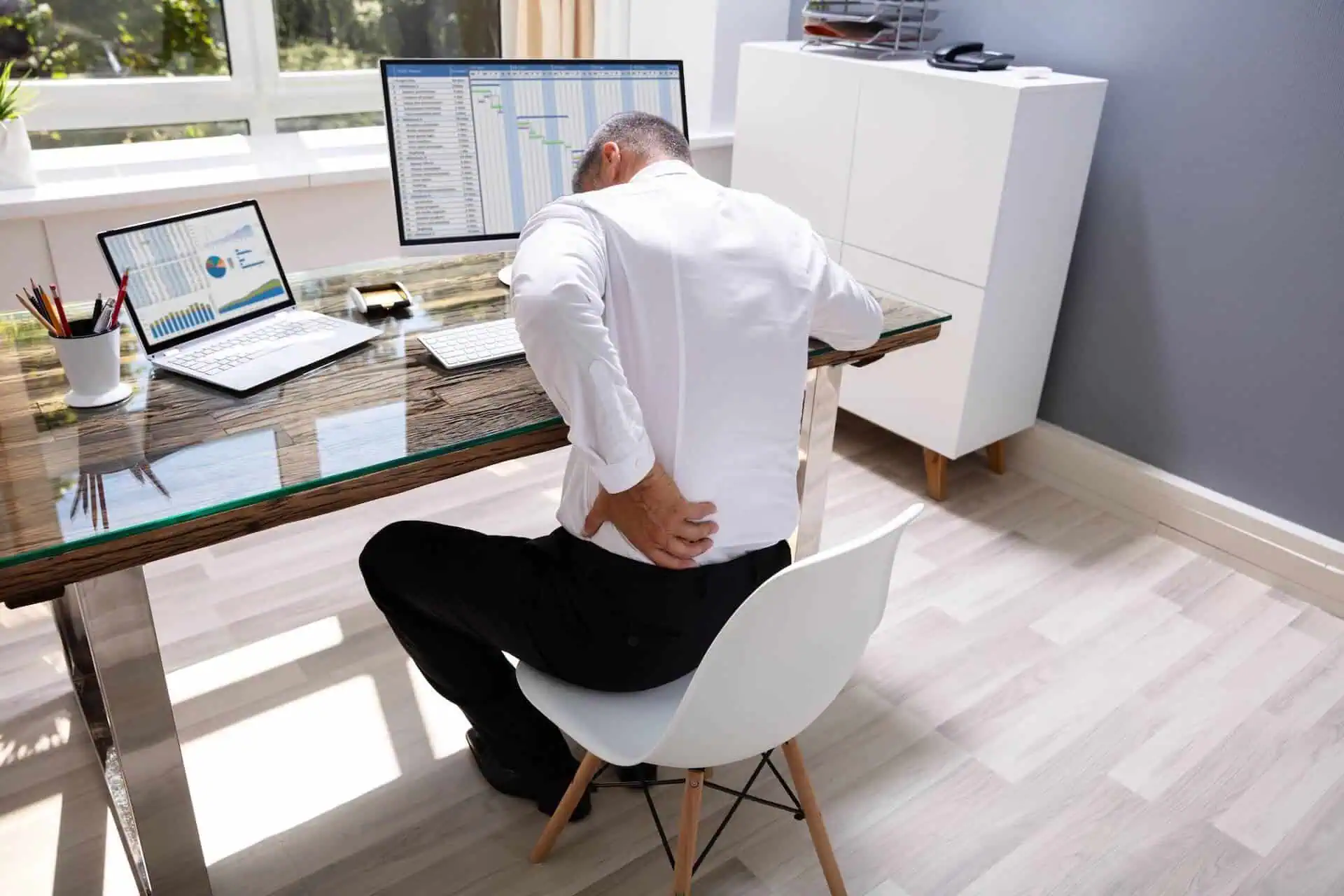
You have the standing desk. You have the ergonomic chair, or you tried one and gave it back. You have a lumbar cushion, or you had one until it started migrating around your lower back. You have an app that reminds you to stand up every 30 minutes, or you did until you turned it off because it was interrupting meetings.
You know your posture is not great by mid-afternoon. You have watched the videos. You have read the articles that told you sitting is the new smoking. And by 3 or 4 pm your low back, your neck, or your shoulders are aching in the same familiar pattern they have been aching in for months or years.
Here is what most of the advice you have been given misses. The problem is not really the sitting.
What Is Actually Producing the Pain
Your body handles almost any position remarkably well for short periods of time. Sitting, standing, walking, kneeling, lying down. None of them are inherently harmful. What causes tissue to complain is holding any one of them long enough that certain structures get overloaded while others go quiet.
When you sit in the same chair, at the same desk, in roughly the same position for eight hours a day, the muscles that keep you in that position stay under continuous low-level load. The muscles that would normally be supporting other positions stop being asked to work. Some tissues get compressed for hours at a time. Blood flow through those areas decreases. The nervous system stops paying much attention to the region because nothing new is happening there. Over months and years, the body adapts to what it is being asked to do, which in this case is very little that is varied.
This is not a story about a bad posture or a bad chair. It is a story about load monotony. Any position held long enough becomes stressful. Any position varied often enough becomes tolerable. The chair is not the villain. The absence of variation is.
Why the Standing Desk Was Not the Answer
Standing desks are not bad. They can help. But they solve one specific problem, which is the amount of time spent seated, without solving the underlying one, which is how little variation the body is seeing throughout the day.
Someone who stands in the same posture at their desk for hours at a time is experiencing a different set of overload patterns than someone who sits, but they are still experiencing load monotony. The knees lock. The pelvis tilts into a fixed pattern. The muscles along the back of the leg stay under continuous low-level tension. The neck often ends up further forward than it does when seated, because the monitor height is now more difficult to get right. This is why many people who bought standing desks discovered that their pain shifted rather than resolved.
The reader who tried a standing desk and found that it did not fix the problem was not doing it wrong. They were addressing the wrong variable. Position matters less than the pattern of positions across the day, and swapping one static position for another does not fundamentally change the pattern.
What Actually Changes the Pattern
The intervention that works for load monotony is straightforward in principle and requires a small shift in how you think about the workday. The goal is not to find the perfect position. The goal is to introduce enough movement variation that no single tissue is being asked to hold the same job for too long.
This does not require gym breaks, mid-morning workouts, or elaborate movement routines. It requires small, frequent changes in what your body is doing. The math matters here. A ten-minute walk at lunch does not offset seven and a half hours of sitting still. What offsets it is thirty separate moments across the day where your body was asked to do something different than what it had just been doing.
For the reader who has tried the standing desk, this reframes the workday from a series of static positions to be optimized into a series of small variations to be introduced. That shift, more than any equipment purchase or ergonomic adjustment, is what tends to move the pain.
Practical Ways to Introduce Variation, No Equipment Required
Here is what this looks like in practice. None of it requires standing desks, gym breaks, or blocks of time you do not have.
Change What Your Body Is Doing While You Are on Calls
Calls are one of the highest-leverage opportunities in the workday because your voice matters and your posture does not. Walk during phone calls if the call does not need video. Stand and lean against a wall for a few minutes. Sit on the floor for a portion of it. Move to a different room. The goal is not to be productive during the call. The goal is to give your body something different to do while you are still fully participating in the meeting.
Change Positions Within Sitting
Sitting itself has more variation available to it than most people use. Sit forward on the edge of the chair for a while, then back into it. Cross one leg, then the other, then neither. Sit on the floor with your back against the wall for a portion of a task. Move to the couch for a task that does not require a monitor. The point is not that any of these positions is better than the others. The point is that your body is doing something new every 20 or 30 minutes rather than being locked into one arrangement for hours.
Use Small Transitions Deliberately
Every time you get up from your chair (to refill water, use the bathroom, grab a snack, print something) is a movement opportunity that most people rush past. Take the long way. Add ten steps in each direction. Roll your shoulders through their full range before you sit back down. Stand on one leg while you wait for the microwave. None of these are exercises. They are ordinary movements you already have to make, done with a bit more attention to the range and variation your body is getting.
Move Through Ranges You Do Not Use During the Day
The muscles and joints that go quiet during a workday are not the ones you use to type, click, or scroll. They are the ones responsible for reaching overhead, rotating through the mid-back, extending the hip behind you, and squatting to the floor. These are ranges of motion your body has, and losing regular access to them is what makes them progressively harder to reach. Once a day, deliberately use them. Reach overhead in both directions. Rotate your torso as far as it will comfortably go on each side. Squat down to pick something up off the floor rather than bending at the waist. None of these are exercises. They are the ranges of motion your body owns and needs to keep using in order to hold on to them.
Change What Your Eyes Are Doing
A significant portion of desk-related neck pain is not really a neck problem. It is an eyes problem that produces a neck compensation. Staring at a fixed distance for hours creates sustained tension in the muscles that hold your eyes in that position, which pull on the muscles at the base of your skull. Every 30 minutes or so, look at something at a completely different distance for 20 or 30 seconds. Out the window if you have one. Across the room if you do not. This gives the visual and postural system a reset that does not require you to leave your desk.
What to Stop Asking Ergonomics to Do
The biggest shift most desk workers can make is not about how they sit. It is about what they expect their setup to solve for them.
The right chair, the right desk height, and the right monitor position can reduce the intensity of overload in a specific tissue. That is a real benefit and it is worth getting right. What none of those adjustments can do is create movement variation, because they are, by design, fixed arrangements. A workspace can be optimized. It cannot be dynamic on your behalf. The variation has to come from you.
This is worth naming because a significant amount of time, money, and mental energy goes into hunting for the perfect ergonomic setup, and the pursuit sometimes replaces the actual work that would change the pain. The reader who spent six months researching chairs and still hurts is not looking in the wrong catalog. They are looking in the wrong direction entirely. The setup was never going to solve the problem, because the problem is not what the setup is for.
What to Notice About Your Own Workday
Before you change anything, spend a day paying attention. How long did you stay in one position without moving? Was it two hours? Four? Longer? Which parts of your body ached first, and when did the aching start? At what point in the afternoon did your posture noticeably deteriorate?
Then notice something else. What happened during the periods when you did move? Did you feel a temporary relief that faded once you sat back down? Did certain activities (walking to lunch, standing during a call, taking the stairs) leave you feeling looser or more comfortable in a way that lasted?
Those observations tell you where your workday is producing load monotony and where you already have opportunities to introduce variation you may not be using. Most people are surprised by how much room there is between what they are doing now and what a well-varied day could look like, without adding equipment or changing much about the work itself.
When Desk-Related Pain Warrants a Closer Look
If you are looking to introduce more variation into your workday, or you have been trying and your symptoms are not shifting, or if your pain is severe enough that it is affecting your sleep, your workouts, or your quality of life, an assessment at DPT can help identify what is actually driving your symptoms and what specifically will change them.