

Nerve pain does not behave like other pain.
It burns instead of aches. It shoots down the leg or into the arm in a line that follows no obvious muscle. It tingles for no clear reason, then goes silent for a day, then flares again while you are sitting still. Some days it is a dull hum in the background. Other days it is sharp enough to change how you sleep, how you sit, how you cross your legs.
If you have been dealing with this for months, you have probably been told a lot of different things. That you have a pinched nerve. That your disc is pressing on something. That you have nerve damage. That you might need to see a specialist. That you should try gabapentin. That the imaging showed something, or that the imaging showed nothing, and either way you are still hurting.
Here is what most of those explanations miss. Nerves are living, moving tissue. And in the majority of chronic nerve pain cases, the problem is not that the nerve has been damaged. It is that the nerve has lost the ability to move the way it was designed to.
Nerves Are Supposed to Move
Most people picture nerves as fixed wires running from the spine to the fingertips or toes. They are not. Every nerve in your body is a living structure that slides and glides through the tissues around it every time you move.
When you reach for something on a high shelf, the nerves running down your arm move several centimeters through the tissues surrounding them. When you bend forward to tie your shoe, the nerves running down your legs slide through the muscles, joints, and connective tissue along their path. This movement is not incidental. It is essential. The nerve needs to be able to travel through its container in order to function without irritation.
When that ability is compromised, the nerve stays put while everything around it moves. It gets tugged on. It gets compressed. It gets rubbed against tissue that should be sliding past it. And it responds the way any irritated tissue responds, except its response is not soreness or stiffness. Its response is the specific set of sensations that nerve pain patients know well: burning, tingling, shooting, electric, numb, hot, cold, and every combination in between.
This is why the pain does not seem to correlate with what you were doing. You were not lifting anything heavy. You did not fall. Nothing traumatic happened. The nerve simply spent enough time getting pulled, compressed, or restricted that it began generating a signal your brain interprets as pain.
Why the Standard Approaches Rarely Solve It
The most common treatments for nerve pain address the symptom, not the mechanical situation producing it.
Medications like gabapentin quiet the nerve’s ability to generate a pain signal. They can provide real relief while they are in your system. But they do not change whether the nerve is being tugged on or compressed in the first place. When the medication wears off or you try to come off it, the underlying situation is unchanged and the symptoms return.
Injections can reduce inflammation in the area around a nerve, which temporarily reduces the irritation and can provide meaningful relief. This is genuinely useful in the right situation. But an injection does not restore the nerve’s ability to slide through its container. It buys time. What happens in that time determines whether the relief lasts.
Stretching can help in some cases and make things worse in others. If the nerve is being compressed by tight muscle, gentle mobility work in the right direction can offload it. But aggressive stretching of an already irritated nerve often worsens the symptoms significantly, which is why many people find that yoga or hamstring stretches make their leg symptoms worse rather than better. The stretch is pulling on a nerve that was already asking for less tension, not more.
Surgery has its place, particularly in cases of severe nerve compression with progressive weakness or clear structural issues. But for most people with chronic nerve pain, surgical intervention is not the answer that the symptoms are actually asking for. The mechanical drivers can be addressed non-invasively when the assessment identifies them correctly.
What Is Actually Restricting the Nerve
Nerve mobility can be compromised at several places along the nerve’s path. Understanding where and why is what separates a treatment that resolves the problem from one that manages it indefinitely.
- At the spine, where the nerve exits the spinal column. Restricted joint motion, disc-related changes, or tight muscles in that area can pull on or compress the nerve at its origin.
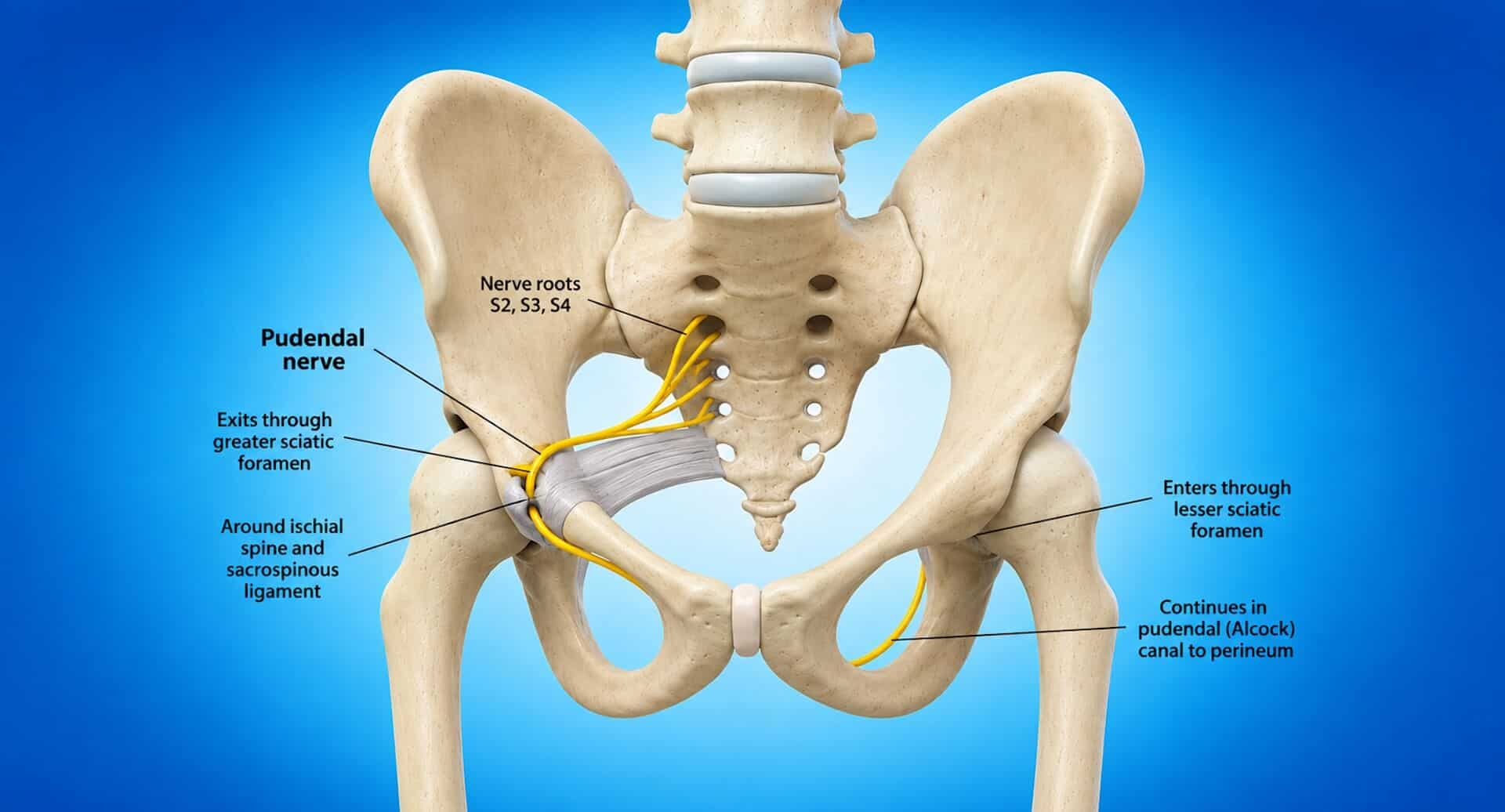
- Along the muscular path the nerve travels. Deep muscles that have shortened or guarded can wrap around a nerve like a fist, restricting its ability to slide as you move. The piriformis in the deep buttock, the scalenes in the neck, and the pronator teres in the forearm are common examples where muscle tension directly restricts nerve movement.
- At joint segments where the nerve crosses. The nerve running down your arm crosses your shoulder, elbow, and wrist. The nerve running down your leg crosses your hip, knee, and ankle. Restriction at any of these joints changes how the nerve moves through that section.
- In the fascial and connective tissue surrounding the nerve. Scar tissue from an old injury, chronic postural patterns, or prolonged sedentary positions can gradually reduce the space around a nerve, restricting its ability to slide freely.
- Anywhere the nerve has to pass through a tight space that has become tighter over time. Some of these are anatomical (the carpal tunnel at the wrist, the thoracic outlet at the shoulder). Others are functional, produced by how a person moves and holds themselves over years.
Notice that in most of these scenarios, the nerve itself is not damaged. It is being restricted by structures around it that have changed. That distinction matters because damage requires healing, which is a slow biological process. Restriction requires mobilization, which is addressable.
What Actually Restores Nerve Function
Movement-based physical therapy for nerve pain does not primarily aim to reduce inflammation or block pain signals. It aims to restore the nerve’s ability to move through its container. When the nerve can slide the way it is supposed to, the mechanical driver of the irritation is removed, and the symptoms tend to resolve as the tissue calms down.
Restoring Motion at the Source
If the nerve is being pulled on at the spine, restoring joint motion in that segment is often the first priority. This is where skilled manual therapy earns its place. Improving mobility at a spinal segment that has stiffened releases tension on the nerve exiting from that level and can produce meaningful change quickly.
Releasing the Muscles That Are Compressing
Where deep muscle tension is compressing a nerve along its path, addressing that tension directly matters. This is where dry needling is often particularly useful because it can reach the deep muscles (piriformis, scalenes, and others) that hands alone struggle to release effectively. Reducing the guarding gives the nerve the room it needs to move.
Neural Mobilization
This is the technique that most distinguishes movement-based nerve pain treatment from what most people have tried. Neural mobilization uses specific, gentle movements of the joints along the nerve’s path to encourage the nerve itself to slide through its container. Done correctly, it is not stretching the nerve. It is helping the nerve remember how to move. The right neural mobilization for a given nerve depends on where the restriction is, and it is often wildly different from the stretches people have tried on their own, which is part of why self-directed nerve stretching so often backfires.
Movement Retraining
Once the nerve is moving better, the postures and movement patterns that produced the restriction in the first place have to change, or the restriction returns. This is where the assessment matters. Someone whose nerve pain traces back to sustained rounded posture at a desk needs different work than someone whose pain traces back to a specific hip movement pattern during running. Movement retraining takes the mechanical improvement and makes it durable.
How to Tell If Your Nerve Pain Is Restriction-Based
There is a specific pattern that suggests a nerve mobility problem rather than something structurally more serious. It is worth paying attention to.
Restriction-based nerve pain tends to change with position. If your leg symptoms are worse when you sit for a while but ease when you stand and walk, or if your arm symptoms flare when you sleep on one side and settle when you shift, that positional variability suggests the nerve is being loaded and unloaded by how you are situated. That is mechanical. That is addressable.
It also tends to be provoked by specific movements. Reaching in a certain direction. Bending a certain way. Sitting cross-legged. Turning your head to check a blind spot. When a specific movement reliably brings on the symptom and a specific movement can ease it, the nerve is responding to load rather than reporting damage.
Signs that warrant more urgent attention include progressive weakness in the affected limb, loss of bowel or bladder control, or a sudden dramatic worsening after a specific incident. Those situations need medical evaluation. But for the far more common presentation of chronic tingling, burning, or shooting sensations that come and go, that shift with position, and that have not responded to the standard approaches, restriction is often the answer, and it is often addressable.
When Nerve Pain Warrants a Closer Look
If your nerve pain has been present for weeks or months, if it responds to medication or injections but returns when they wear off, if it changes with position or movement, or if you have been managing it with the sense that no one has actually figured out what is causing it, an assessment can identify where the nerve is being restricted and what specifically needs to change.
Nerves are more responsive to the right work than most people expect. The tissue around them is remarkably adaptable when the mechanical situation is addressed correctly. The reason chronic nerve pain often feels permanent is not that it is. It is that most of what people have tried has not gotten to the mechanical driver.
If your nerve pain has been holding you back from things you want to do, a movement assessment at DPT can identify what is actually producing it and whether the drivers are ones that respond to movement-based care. A discovery visit is a practical way to start that conversation.